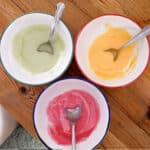
Natural Cookie Glaze
Stop fighting your natural glaze. This guide covers every powder, liquid, and technique for natural food coloring for cookies that pipes cleanly and dries beautifully.
Servings 24 cookies
Calories 26kcal
Equipment
- spoon and toothpick
- Small glass or ceramic bowls
Ingredients
- 150 g Powdered sugar
- 2.5 tablespoon Milk
- 1 teaspoon Honey or maple syrup
- ½ teaspoon Lemon juice
- Freeze-dried fruit powder
Instructions
- Sift the powdered sugar. Use a fine-mesh sieve. This step protects your piping tip and your flow. Lumps do not break down once the sugar is wet.150 g Powdered sugar
- Add the wet ingredients. Pour in 2 tablespoons of milk, 1 teaspoon of honey, and lemon juice if you're using it. Start with 2 tablespoons of milk even if the glaze looks thick. You can always add more; you can't take it back.2.5 tbsp Milk, 1 tsp Honey, ½ tsp Lemon juice, Freeze-dried fruit powder
- Whisk until smooth. Use a small whisk and stir in tight, controlled motions for about 30 seconds. Don't overwork it — too much air creates bubbles on your finished cookies.
- Do the ribbon test. Lift the whisk and let the glaze fall back into the bowl. It should form a thick ribbon that sits on the surface for 5–8 seconds before softening and disappearing. If it levels instantly, it's too thin. If it doesn't soften at all, it's too thick. Adjust with milk (half a teaspoon at a time) or powdered sugar (one tablespoon at a time) and test after every adjustment.
- Divide and add color. Once you have ribbon consistency, divide the glaze into separate bowls — one per color. Add your freeze-dried powder a quarter teaspoon at a time, whisking fully between additions. If the glaze thickens after adding pigment, adjust with milk a drop at a time. Do the ribbon test again before piping.
- Transfer to piping bags. Snip the tip small — you can always make it bigger. Test on parchment before you commit to a cookie.
- Pipe at a 45-degree angle. Let the glaze fall naturally onto the cookie. Don't press hard. Steady movement gives you clean, consistent color.
Notes
Getting ribbon consistency right before you add any pigment is non-negotiable. Powdered colors absorb liquid slightly as they hydrate, so your glaze will always tighten a little after adding color. If you add pigment to a glaze that's already on the thin side, it won't tighten enough to recover — it will just bleed. Nail the ribbon first, then add color and re-test.
Nutrition
Calories: 26kcal | Carbohydrates: 7g | Protein: 0.1g | Fat: 0.1g | Saturated Fat: 0.03g | Polyunsaturated Fat: 0.002g | Monounsaturated Fat: 0.01g | Cholesterol: 0.2mg | Sodium: 1mg | Potassium: 3mg | Fiber: 0.001g | Sugar: 6g | Vitamin A: 3IU | Vitamin C: 0.04mg | Calcium: 2mg | Iron: 0.01mg
