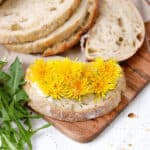
Sourdough Dandelion Flower Bread - Homemade Recipe
This golden dandelion bread recipe uses fresh sourdough and foraged petals for a subtly floral spring loaf you'll want to bake every year
Servings 16
Calories 161kcal
Equipment
- Scissors
- KitchenAid or Stand mixer with dough hook Stand mixer method only
- Large mixing bowl Stretch and fold method only
Ingredients
- 950 g bread flour
- 500 g filtered water
- 20 g salt
- 200 g active sourdough starter
- 1 - 2 cups of cut dandelion petals
- 1 teaspoon olive oil
Instructions
Prepare the Dandelions
- Find good places to forage: your own untreated lawn or any wild edible plants area well away from roads and weed killers. Look for bright yellow, fully open dandelion heads. Shake or spin in a salad spinner to remove bugs. Do not wash them — rinsing strips the pollen and natural aromas. Snip the yellow petals from the flower heads with scissors, leaving all green parts and green sepals behind. Any green bits will make the bread taste bitter rather than floral.
Method 1: Stretch and Fold
- In a large mixing bowl, combine the flour and water. Mix until no dry flour remains — the dough will look shaggy. Cover and rest for 30 minutes.
- Add salt and starter. Add the sourdough starter and salt diluted in a little bit of water directly to the dough. Use wet hands to squeeze and fold everything together until fully incorporated. Cover and rest for another 30 minutes.
- Add the dandelion petals.Turn the dough out onto a well-floured surface. Stretch it out gently into a rough rectangle and scatter the dandelion petals evenly across the surface. Fold the dough like a letter — bottom third up, top third down — then fold in the sides. Return to the bowl.
- Stretch and fold. Over the next 1.5–2 hours, perform 3–4 sets of stretch and folds every 30 minutes. For each set, wet your hands, grab one side of the dough, stretch it up and fold it over itself. Rotate the bowl 90 degrees and repeat — four folds per set.
- Bulk fermentation. After the final fold, cover and leave the dough to bulk ferment at 23°C (73°F) for 4–5 hours, or until it has risen by about 60%. The dough should feel airy and show bubbles on the surface and sides.
- Shape and cold proof. Turn the dough onto a lightly floured surface and divide into two with a bench scraper. Fold the edges of each piece toward the centre, pinch the seam, and flip seam-side down. Use your hands or the bench scraper to drag each loaf in a circular motion to build surface tension. Place seam-side up in well-floured bannetons, cover, and refrigerate overnight.
- Preheat your oven to 300°C (570°F) with the Dutch oven inside for a full hour. Turn one loaf out onto parchment paper and score with a lame or sharp knife. Lower carefully into the Dutch oven. Cover and bake 20 minutes without opening the lid. Remove the lid, reduce to 250°C (480°F), and bake another 15 minutes until lightly golden. Cool on a wire rack for at least one hour before slicing.
Method 2: Stand Mixer (KitchenAid)
- Mix the dough. Add the flour, water, sourdough starter, and salt to the bowl of your stand mixer. Mix on low with the dough hook for 5–7 minutes until the dough is smooth, supple, and pulls away from the sides of the bowl. In the final 30 seconds, add the dandelion petals and let them incorporate gently — adding them at the end preserves their colour and structure.
- Bulk fermentation. Drizzle a teaspoon of olive oil into a large bowl, transfer the dough, cover, and ferment at 23°C (73°F) for 4–5 hours, or until risen by about 60%. Because the stand mixer develops gluten more quickly than stretch and fold, the dough will feel stronger going into bulk fermentation — this is normal.
- Shape, cold proof, and bake. Proceed exactly as Method 1 from the shaping step onward.
Video
Notes
Don't wash the petals — you'll lose everything that makes this bread special. And pick in the morning. Petals harvested between 8–11 AM are sweeter, more aromatic, and hold their yellow colour better in the crumb. Next time you walk past a field of dandelions, stop and fill your pockets.
Nutrition
Calories: 161kcal | Carbohydrates: 45g | Protein: 6g | Fat: 1g | Saturated Fat: 0.1g | Polyunsaturated Fat: 0.3g | Monounsaturated Fat: 0.2g | Sodium: 487mg | Potassium: 64mg | Fiber: 2g | Sugar: 0.2g | Calcium: 10mg | Iron: 3mg
