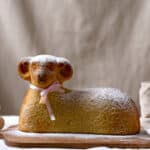
How to Make Easter Lamb Cake {Easy Czech Recipe}
Lamb Cake is another traditional Czech Easter recipe that is easy to make and kids love it!
Servings 8
Calories 643kcal
Ingredients
- 520 g all purpose flour
- 205 g confectioners sugar
- 20 g baking powder
- ½ teaspoon salt
- ½ teaspoon lemon zest
- 405 g whole milk
- 205 g olive oil
- 4 large eggs
- 45 g rum
Instructions
- Preheat your oven to 180°C. Make sure it's fully up to temperature before the batter goes in.
- Mix the dry ingredients. Combine the flour, confectioners' sugar, baking powder, lemon zest, and salt in a large bowl and whisk until evenly distributed.
- Whisk the eggs and milk. Beat together with an electric mixer on medium speed or a hand whisk until smooth and slightly frothy.
- Combine and add rum. Add the dry ingredients to the wet, pour in the olive oil and rum, and mix on low speed until the batter is smooth. Stop as soon as everything is combined — overmixing makes the cake dense.
- Prepare the lamb cake pan. Grease both halves of the lamb mold thoroughly with cold butter, working it into every crevice of the lamb's face, ears, legs, and neck. Dust all surfaces with a thin layer of flour, shaking the prepared pan to coat evenly, then tap out the excess. You can substitute breadcrumbs for the flour, if you're worried your cake will stick to the mold.
- Fill the mold. Fill the mold completely with cake batter. Place it in your preheated oven on a cookie sheet or baking sheet — this stabilizes the mold and catches any extra batter that escapes through the vent hole.
- Bake for 60–70 minutes. Check at 60 minutes by inserting a wooden skewer into the thickest part. If it comes out clean or with just a few moist crumbs, you're done.
- Rest 10–15 minutes, then unmold warm. Set the mold on a wire rack and let cake cool for 10–15 minutes. The cake needs to still be slightly warm when you unmold it — not hot, not cold. Gently open and lift off the top mold. Then turn the bottom half upside down for the cake to slide out. If it resists, tap lightly on the counter.
- Cool completely, then decorate. Let the lamb cool fully on a wire rack before transferring to a serving platter. Dust generously with powdered sugar for the classic white cake look. For a traditional touch, tie a thin ribbon around the lamb's neck — it hides the seam line beautifully.
Video
Notes
Know your mold. Ceramic and cast aluminum molds produce the sharpest features — the lamb's face and wool texture come out with real definition. Non-stick metal is more forgiving for first-timers but gives softer detail. Silicone releases easily but the lamb loses its shape — skip it if presentation matters to you.
The most important thing I've learned: match your batter volume to your specific lamb cake mold. Too little and the beránek is hollow; too much and it overflows the seam. Here's how — fill the mold with water, then weigh the water. That weight in grams is your target batter amount. My mold holds 1600g, which is exactly what this recipe is calibrated for. If yours is different, use an AI tool to scale the recipe: "Scale this lamb cake recipe from 1600g of batter to Xg, adjusting all ingredients proportionally." It takes 30 seconds.
Unmold warm, not cold. The 10–15 minute window after the mold comes out of the oven is your sweet spot. Most broken lambs happen because someone waited too long.
Nutrition
Serving: 285g | Calories: 643kcal | Carbohydrates: 78g | Protein: 12g | Fat: 30g | Saturated Fat: 5g | Polyunsaturated Fat: 3g | Monounsaturated Fat: 20g | Trans Fat: 0.01g | Cholesterol: 99mg | Sodium: 467mg | Potassium: 182mg | Fiber: 2g | Sugar: 28g | Vitamin A: 217IU | Vitamin C: 0.2mg | Calcium: 234mg | Iron: 4mg